
For Immediate Release
Space for Grief™ Unveils Free Public Art Experience Across 10 Toronto-area Cemeteries for Mount Pleasant Group’s 200th Anniversary


TORONTO, ON [August 18th, 2026] - Space for Grief™, an internationally recognized public art and research initiative created by Toronto-based Method Collective, has created a free, distributed living museum across all 10 Mount Pleasant Group cemeteries in the Greater Toronto Area.
Now open to the public, Yesterday. Today. Forever. commemorates two centuries of Mount Pleasant Group, an institution whose origins predate Toronto’s incorporation as a city, and marks Space for Grief’s most ambitious public commission to date. Drawing on archives, landscapes and community histories, the site-specific project combines sculpture, projection, original soundscapes, participatory storytelling and spaces for reflection.
Each location responds to its own architecture, ecology and surrounding communities, while together they reveal how migration, ritual, land and loss have shaped Toronto and the region extending to its Indigenous roots. The experience invites people to see cemeteries differently, not only as places of mourning, but as civic spaces where personal memory meets public history, and where visitors can encounter art, spend time in nature and contribute their own stories to the city’s living archive.

10 landscapes, 5 ways to encounter memory
Visitors can walk through a doorway, step inside a soundscape, leave a message, watch an artwork change with the light, and follow Toronto’s history across the landscape. Highlights include:
Walk through a reclaimed portal: Mount Pleasant and Prospect cemeteries
Doors once belonging to buildings across the Greater Toronto Area become walk-through sculptures and thresholds between past and present. As visitors cross through them, they are invited to consider transition, changing perspectives and what we carry forward. Reclaimed and reimagined, the doors give pieces of the region’s built history a second life.Enter We Remembered the Monoliths: Toronto Necropolis
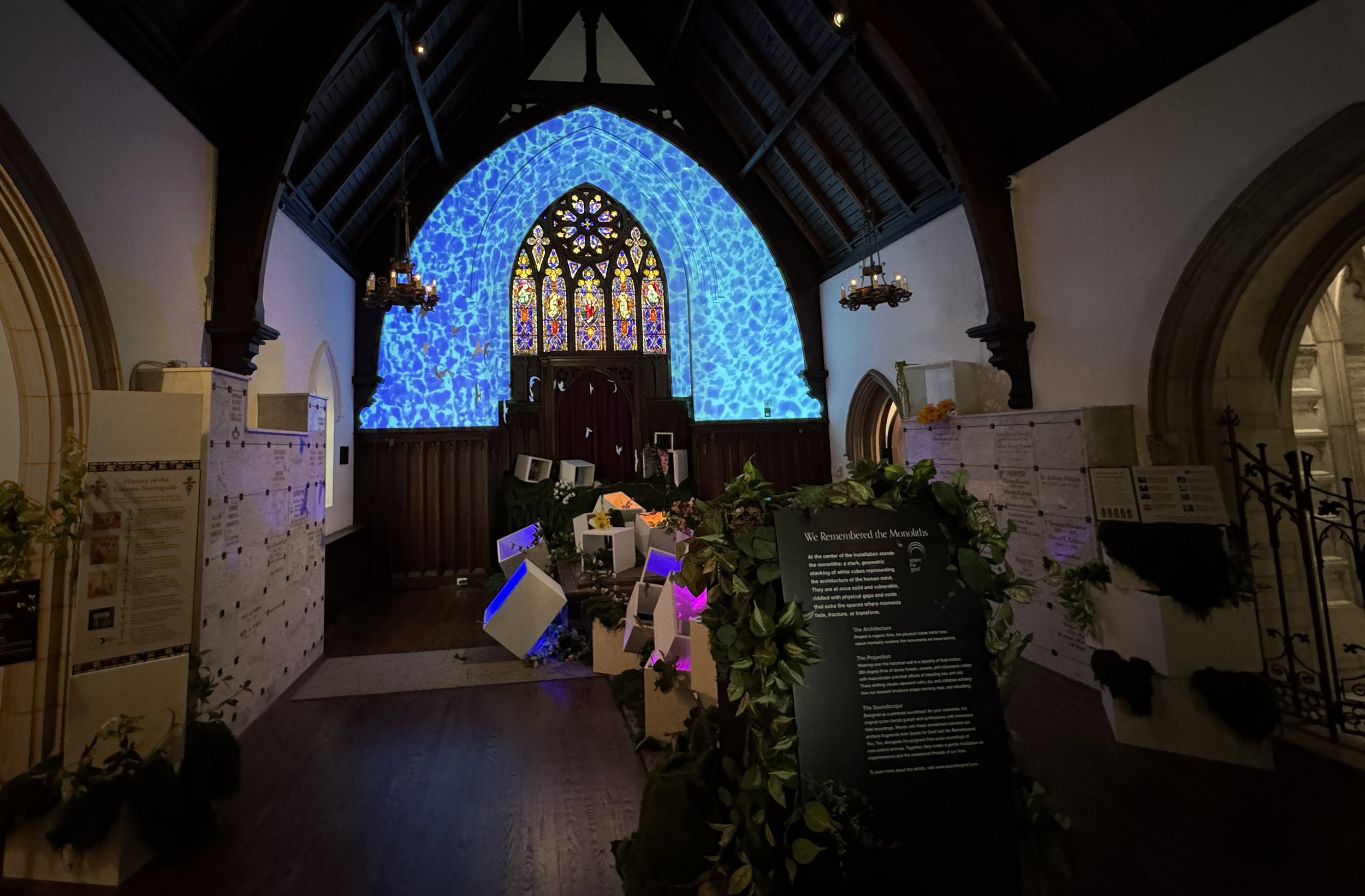
This sculptural projection and sound installation explores what memory preserves, distorts, and remakes. Moving imagery, including footage by South African scientist and underwater filmmaker Justin Blake, whose work includes BBC’s Planet Earth III, moves across the forms alongside an original soundscape led by Ziyan Hossain. Produced by Space for Grief, the work brings together co-compositions with acclaimed Australian guitarist Plini, Berklee Power Station Studios engineer and producer Henry Reinach, and award-winning writer and activist Sandy Hudson.Leave a message in the Memory Gardens: York, Meadowvale and Thornton cemeteries
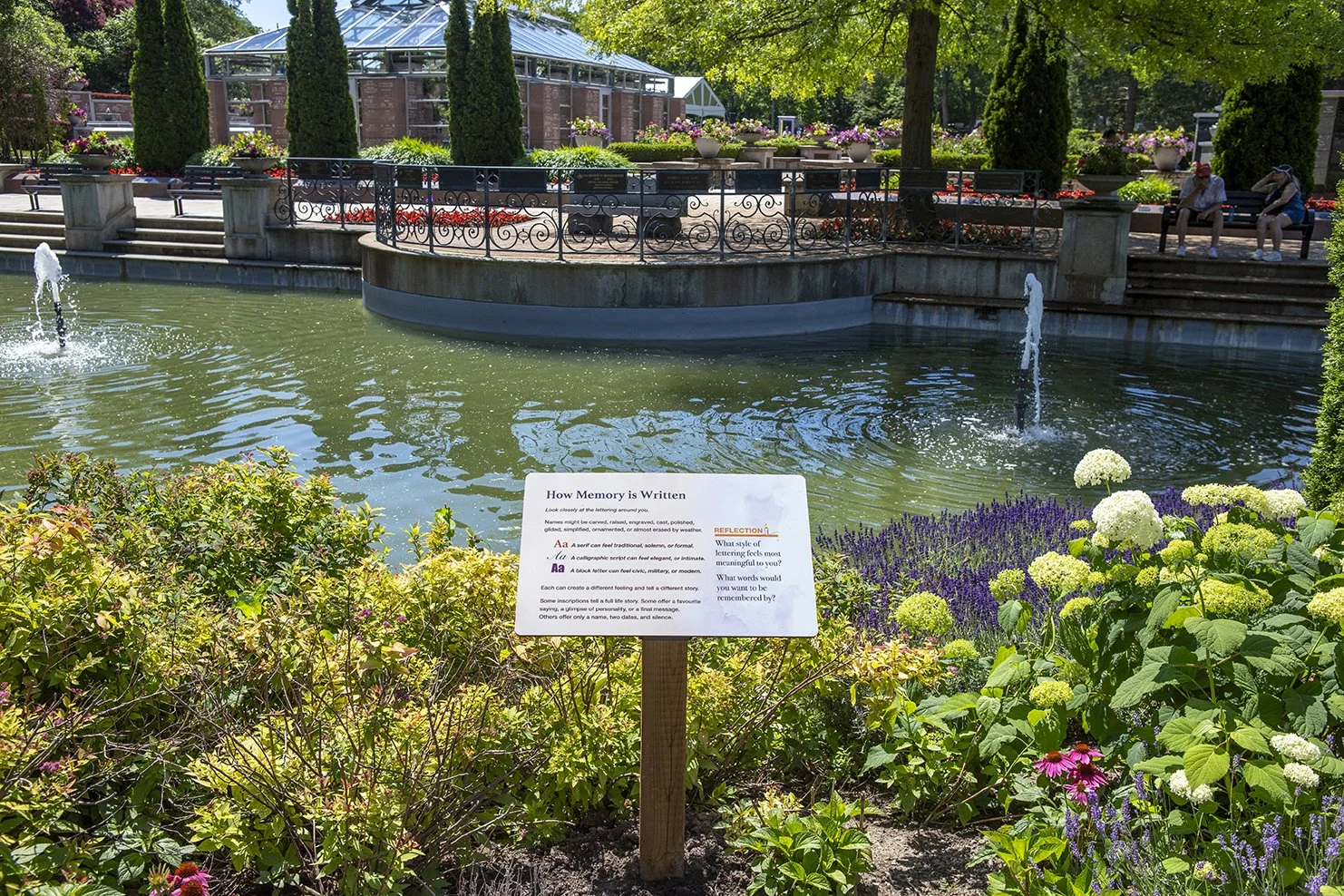
Visitors are invited to write to someone - or something - they have lost. Their messages are displayed on translucent, bird-shaped cards that gather into layered murmurations of remembrance. Growing with every contribution and carrying many voices and languages, each garden becomes a collective artwork created by its visitors.Watch Murmurations shift : Pine Hills Cemetery
Translucent birds shift in colour as the light changes and visitors move around them, meaning no two people see the installation in exactly the same way. Flying together, they evoke the many communities connected through Mount Pleasant Group and offer a simple reflection: even shared experiences can look different depending on where we stand.Walk through 200 years of city history: all 10 locations
Museum-style outdoor interpretation transforms each visit into a self-guided journey through Toronto and the surrounding region. Historical timelines, archival stories and reflective prompts connect individual lives with migration, architecture, public health, ecology, and the city’s continuing evolution.
“This is more than art simply placed in cemeteries,” said Ziyan Hossain, co-founder and creative director of Method Collective. “These landscapes already hold personal memory, public history, nature, architecture and generations of care. Mount Pleasant Group invited us to treat its bicentennial not only as a retrospective, but as a public question: how do we carry memory forward? Our role was to create new ways into those stories, allowing people to experience history as something they can see, hear, feel and contribute to.”
A 200-year story that began before Toronto was a city
Mount Pleasant Cemetery is one of Toronto’s most significant cultural landscapes hiding in plain sight: an active cemetery, a National Historic Site of Canada and a 205-acre arboretum with one of North America’s finest tree collections: more than 600 species across 120 genera. Its winding paths, rare trees, funerary monuments, and architecture, including work by Old City Hall architect E.J. Lennox, make it part botanical garden, part architectural archive, and part open-air museum.
Its story began before Toronto was a city. In 1825, residents of the Town of York petitioned for a burial ground open to people of every denomination. The resulting legislation established Potter’s Field, Toronto’s first non-denominational cemetery, and a commitment to care in perpetuity that became the foundation of Mount Pleasant Group.
Around the world, historic cemeteries are being rediscovered as places for art, nature, education, and cultural tourism. Yesterday. Today. Forever. places Toronto within that movement, inviting residents and visitors to explore Canadian history, architecture, migration and the natural world; and to discover how individual lives helped shape the city around them.
This placemaking project also puts a focus on “last responders”. While first responders are rightfully recognized for meeting people during moments of crisis, far less visible are Mount Pleasant Group’s “last responders”, the cemetery workers, funeral professionals, groundskeepers, archivists, and family-support teams whose work continues after public attention moves on. Meeting families on some of their most difficult days, they combine demanding physical labour with extraordinary empathy, caring for the deceased, supporting the living, and preserving community memory. Through museum-style interpretive signage and storytelling, the project brings their roles, histories and contributions into public view, recognizing deathcare not simply as a service, but as essential work that helps society carry loss and move through transition.
From immersive art installation to civic-scale practice designed to travel
Space for Grief™ is a Toronto-born public art and research initiative shaped by the city’s many migrations, and by the Canadian, Bangladeshi, Colombian, and Chinese cultural perspectives of co-founders Ziyan Hossain, Fran Quintero Rawlings, and Calla Lee. Its foundations lie in graduate research by Hossain and Quintero Rawlings at OCAD University into death and grief practices, and how emotion influences decision-making, identity, public policy, architecture, and the built environment. This extends to the connection of grief to radical hope, strength, and resilience.
Together, the founders deepened their inquiry through years of Method Collective work across sport, healthcare, law, construction, and community systems. Across these sectors, grief repeatedly surfaced as an often-unspoken influence on trust, risk, relationships, and the ability to imagine change, suggesting that institutions cannot build credible futures without confronting what people and systems have lost.
More than 100,000 people have encountered the installations and contributed over 12,000 written reflections, creating a living archive of love, loss, and transitions.
First presented at the Toronto Reference Library, Space for Grief has since taken shape at Nuit Blanche Toronto, Evergreen Brick Works, and OCAD University. Its research and proprietary Grief-Informed Futures methods have reached international audiences through workshops with the UK’s National Health Service and at the Dubai Future Forum, with new projects now in development in New York City, the United Kingdom and the Asia-Pacific region. The Mount Pleasant Group commission marks its next evolution: a site-responsive practice unfolding across 10 landscapes that hold two centuries of Toronto’s communities, migrations and changing traditions of remembrance.
“Cemeteries ask us to consider time differently not only in years or generations, but through a horizon of perpetuity,” Hossain says. “That perspective changes how we think about land, care, memory, and our responsibility to those who will come after us.”
Plan your visit
Yesterday. Today. Forever. is free and now open across all 10 Mount Pleasant Group cemeteries, with locations in Toronto, North York, Scarborough, Vaughan, Richmond Hill, Brampton, Pickering and Oshawa.
August 18 – October 31: daily, 8am - 8pm
November 1 – March 31: daily, 8am - 5:30pm
The installations will remain in place throughout 2026, with select components continuing into 2027.
Installation details, maps and visitor information: mpg200.ca/installations
Learn more about Space for Grief: spaceforgrief.com
Learn more about Method Collective: methodcollective.ca
———————
Media contacts
Method Collective / Space for Grief hi@methodcollective.ca
Mount Pleasant Group media@mountpleasantgroup.com mountpleasantgroup.com
Media assets can be found here.
About Method Collective and Space for Grief
About Method Collective
Method Collective is a Toronto-based interdisciplinary studio founded by Ziyan Hossain, Fran Quintero Rawlings, and Calla Lee. Working at the intersection of data, human behaviour, and culture, the studio combines systems thinking, behavioural economics, strategic foresight, life-centred design, and art-based methods to uncover dynamics conventional analysis often misses. Method Collective translates these insights into strategies, services and public experiences for organizations navigating complex social and institutional change.
About Space for Grief
Created by Method Collective, Space for Grief™ is an internationally recognized public art and research initiative exploring how cities and institutions make room for loss, memory, and human connection. Part immersive artwork and part civic research platform, it brings grief into public life through multisensory environments, participatory storytelling, and Grief-Informed Futures, a proprietary framework examining how unacknowledged loss shapes decisions, systems and the futures we build.
Creative collaborators have included acclaimed guitarist Plini, artist and musician Kurt Swinghammer, writer and activist Sandy Hudson, and engineer and producer Henry Reinach. Its cross-sector projects and engagements have involved organizations including the UK’s National Health Service, David Suzuki Foundation, Curling Canada, EllisDon, Mount Pleasant Group, Evergreen Brick Works, and the Toronto Public Library.
Space for Grief was recognized through First Deputy Mayor Ausma Malik’s 2026 Champions for Toronto program, while its founders were named 2023 Next Generation Foresight Practitioners Fellows. The team’s work has been presented at more than 20 academic and professional forums, including the Dubai Future Forum, Relating Systems Thinking and Design, and the Association of Professional Futurists.
About Mount Pleasant Group
Established in 1826, Mount Pleasant Group is a non-profit organization providing inclusive, compassionate and choice-driven cemetery, funeral and cremation services across the Greater Toronto Area. Its network includes ten non-denominational cemeteries, nine funeral centres and four cremation centres.
Mount Pleasant Group is committed to supporting families, preserving significant cemetery landscapes and histories, and honouring diverse traditions in perpetuity.